
Editorial Note:
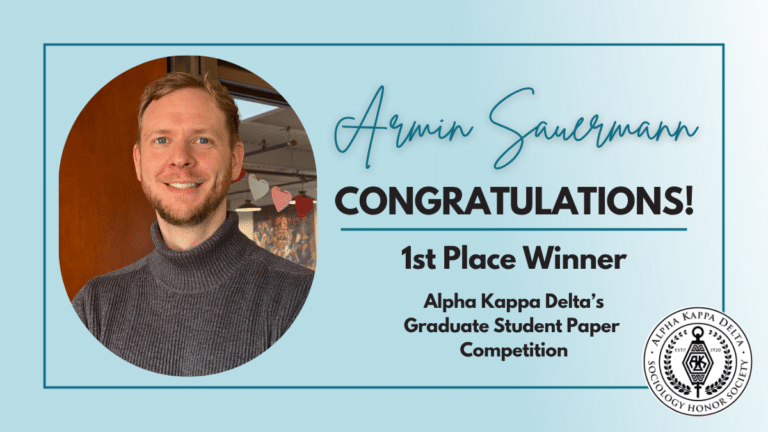
This blog feature was created by the Alpha Kappa Delta (AKD) Media Editor, Stephanie Wilson, in celebration of the first place winner in AKD’s 2026 graduate student paper competition, Armin Sauermann.
Each year AKD sponsors a graduate student paper competition. Winners are eligible to win cash prizes and travel money to attend the American Sociological Association annual conference. The first place winner received $500 and up to $1,000 in travel expenses to the 2026 annual meeting of the American Sociological Association.
Continue reading to learn more about Armin Sauermann’s winning paper!
Meet Armin Sauermann
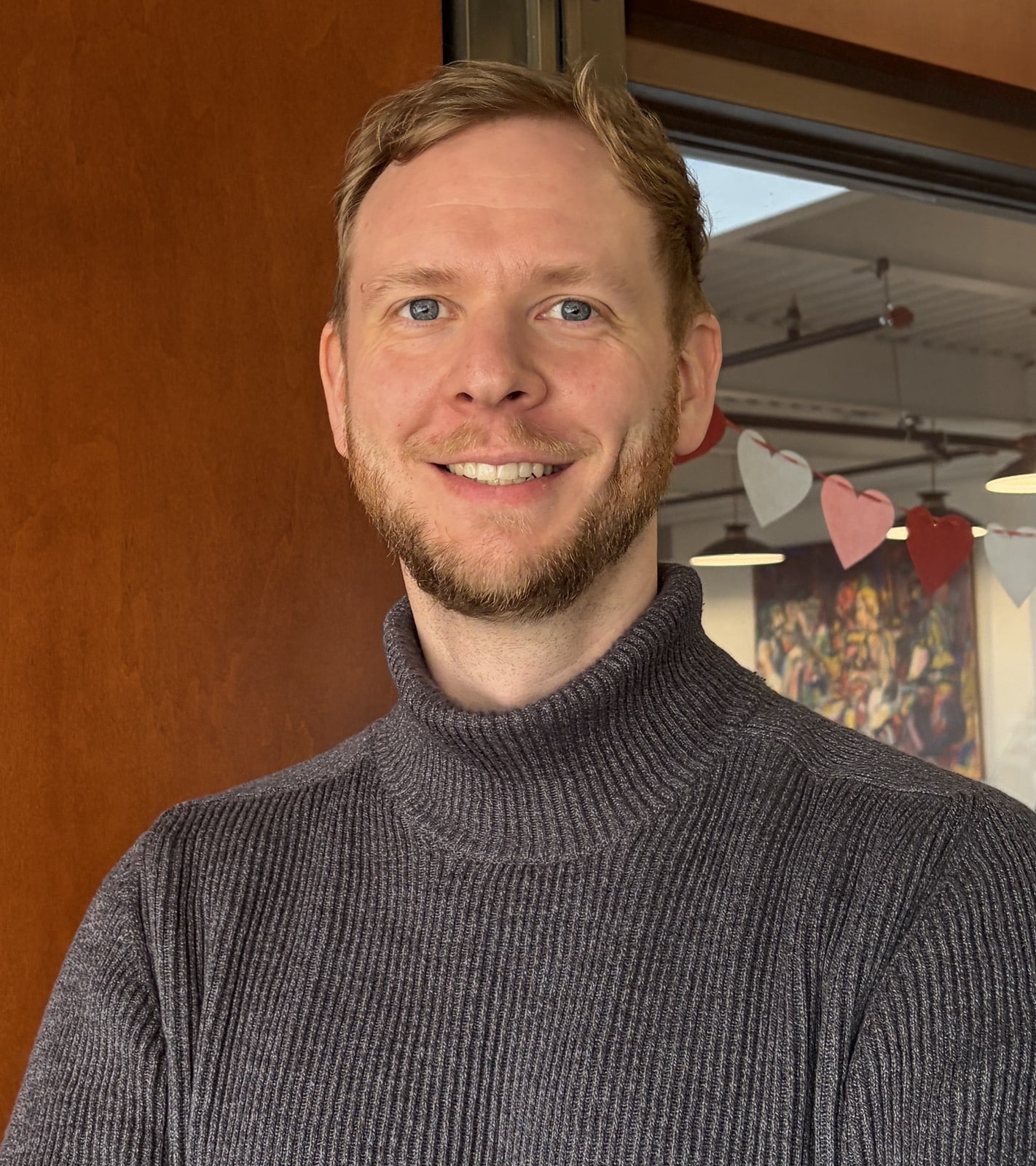
Armin Sauermann is a doctoral student in sociology at Washington University in St. Louis. His research explores the culture and politics of gun ownership in the United States, drawing on both quantitative and qualitative methods to examine the motivations, identities, and meanings associated with firearm ownership. Prior to beginning his doctoral studies, Sauermann worked as a researcher at the WZB Berlin Social Science Center, where he specialized in data processing and the analysis of large-scale observational data. and his paper titled “Social Ties, Not Threat: Explaining Variation in Gun Ownership in the United States” won him a first place prize in the 2026 AKD graduate student paper competition.
To learn more about Armin’s and his research, we reached out for a brief interview. Continue reading below to learn more about Armin, his research, and his future goals as a sociologist! You can also connect with Armin on Bluesky.
Can you briefly summarize your award-winning paper?
In the United States, the dominant stated reason for gun ownership is self-defense, yet the cultural mainstreaming of this narrative unfolded during a period of sharply declining objective risk. This pattern presents a sociological puzzle, which this paper investigates by adjudicating between three explanations: that ownership reflects an instrumental response to perceived threat, an expression of a broader socially conservative worldview encompassing traditional gender and racial attitudes, or social embeddedness in gun-prevalent networks.
Drawing on a nationally representative survey conducted in early 2025, the study employs a novel multidimensional threat battery capturing fear, anger, and perceived likelihood across five concrete scenarios, contrasting these threat measures with cultural orientation and social embeddedness. Even refined measures of perceived threat fail to reliably predict ownership; the threat effects that do emerge are politically bounded. Social embeddedness produces large and consistent effects across every subgroup examined, while social conservatism operates as an independent but secondary pathway, strongest among White men.
The findings suggest that self-defense functions not as a genuine motivator but as a culturally legitimate account people deploy to justify a practice already anchored in their social worlds.
What motivated you to write on the topic of your paper?
Gun culture in the US has been a fascination of mine even back in Germany. It is at the same time maligned and perfectly normal. It represents America’s freedom and violence. Some can’t imagine living without their guns, others can’t fathom why anyone would possibly want a deadly weapon in their home. It is a field full of contradictions, conflicts, and weighty implications. Sociological qualitative literature, especially by Jennifer Carlson, opened my eyes to the possibility that I could actually study this instead of just being passively fascinated by it, so that is what I decided to do in the first semester of my PhD program.
If you had to choose one major takeaway to share from your paper, what would that be?
My main takeaway was methodological. The master’s thesis was an attempt to treat gun ownership with more nuance, especially across sub-groups that are often sidelined by research. But in the end, even with the large sample I had, I was unsatisfied with the conclusions I could draw from this survey work. I realized that to actually understand the meanings and nuances around gun ownership, what I really needed were qualitative methods.
What have been your biggest “aha” moments while studying sociology?
One of the biggest “aha” moments for me was learning to catch the reflex to locate blame in individual action. Instead of solely asking what an individual did wrong, studying the field taught me to step back and ask what wider system, economic conditions, culture, social setting, shaped why that action made sense to the person in the first place.
People still have agency, but that agency always operates within conditions they didn’t choose, and it operates statistically as much as systemically: any population is distributed around its norms, and some people will always fall outside them. That’s not a failure to be corrected, it’s simply what human diversity looks like. Together, these two ideas changed how I read the social world: behavior is shaped by systems, not just individual will, and falling outside the norm is an expected part of life rather than something requiring blame.
How do you see yourself using sociology in your future career after earning your graduate degree?
After many years of studying and working with a sociological perspective, I don’t think it’s so much that I use sociology as that it has become my mode of thinking. I hope to become a professor, conducting research and teaching the field to students, but the truth is that no matter what I end up doing, it will always be through a sociological lens.
Lastly, how has being involved in AKD impacted your experience as a graduate student in the social sciences?
It means a lot to know there’s an organization dedicated to recognizing and supporting sociology students specifically. Knowing that a network of like-minded scholars exists, one that values the work graduate students put into the field, has been encouraging as I continue through my program. I hope to engage more directly with AKD as my career develops.