
Editorial Note:
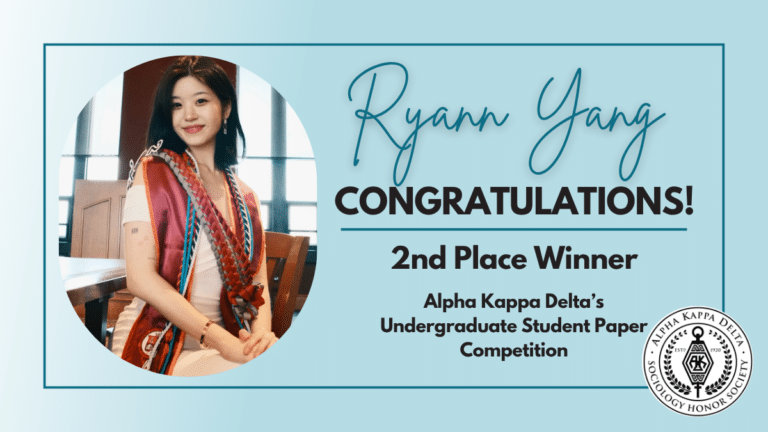
This blog feature was created by the Alpha Kappa Delta (AKD) Media Editor, Stephanie Wilson, in celebration of the second place winner in AKD’s 2026 undergraduate student paper competition, Ryann Yang.
Each year AKD sponsors an undergraduate student paper competition. Winners are eligible to win cash prizes and travel money to attend the American Sociological Association annual conference. The third place winner received $250 and up to $1,000 in travel expenses to the 2025 annual meeting of the American Sociological Association.
Continue reading to learn more about Ryann Yang’s winning paper!
Meet Ryann Yang
 Ryann Yang recently graduated from Virginia Tech University with a bachelor’s in Sociology. Her paper titled “Prestige as Capital: How Ivy League Merit Becomes Structural Advantage“ earned her a second place prize in our 2026 Undergraduate Student Paper Competition.
To learn more about Ryann and her research, we reached out for a brief interview. Continue reading below to learn more about Ryann, her award-winning paper, and her experiences as a sociology student! You can also connect with Ryann on Instagram and LinkedIn.
Can you briefly summarize your award-winning paper?
Prestige has always existed as a powerful form of social recognition in society, but what’s to say it isn’t embedded within education itself? By exploring Ivy League universities as a case study to examine how prestige is created, maintained, and reproduced within higher education, I argued that elite universities do more than develop knowledge and skills. This theoretical analysis, supported by secondary empirical research, mainly drew from the Weberian model of social stratification, Bourdieu’s theory of capital, Goffman’s presentation of self, and Becker’s human capital theory.
Through these frameworks, I realized that prestige also transforms existing economic, cultural, and social advantages into socially recognized credibility by influencing whose achievements deserve to be rewarded. My paper aimed to show that human capital and prestige work together, rather than arguing that merit doesn’t exist, with prestige ultimately acting as a filter that shapes how talent is recognized and then converted into opportunity.
What motivated you to write on the topic of your paper?
As a sociology student, what has been your favorite class and why?
I had two favorite sociology classes at Virginia Tech, which were Social Inequality, taught by Dr. Laura Halcomb, and Deviant Behavior, taught by Dr. Christine McCown. These classes are my favorites because they challenged my pre-existing views and thoughts on certain topics, which made me see things from different perspectives that I wouldn’t have known beforehand. It also shed light onto not only stigmas or stereotypes, but also social structures and hidden inequalities that are present in our daily lives.
These classes helped me figure out what I wanted to focus on with sociological research and explore structural inequality and hidden hierarchies within society.
What have been your biggest “aha” moments while studying sociology?
One of my biggest “aha” moments while studying sociology was realizing that what I thought as normal, may be affected by underlying hierarchies and hidden structures within society. Sociology taught me to look past the surface, and what I learned was that the bigger questions were why they existed and who implemented them. By considering inequality, power, and social norms, we are able to see how they shaped social norms within society. Once I started noticing them, I started recognizing these patterns everywhere which ultimately led me to the types of research questions I am interested in. I enjoy causing others to think and be uncomfortable with what they thought was comfortable through my writing.
If you had to choose one concept, theory, or idea from sociology that has had the biggest impact on how you view the world around you, what would it be and why?
If I had to choose, I would choose Bourdieu’s theory of capital as the one that had the biggest impact on how I viewed the world around me. If people think of capital, they usually think of it within economic terms. But through understanding that there are other forms, such as social and cultural, it puts into perspective that there are hidden advantages that people are unaware of as well. The knowledge people grow up having, the people they know, and even how others perceive their background can eventually translate into real opportunities. It made me realize that sometimes, the most influential forms of advantage are not immediately recognized as advantages at all.
Lastly, how has your involvement with AKD impacted your experience as an undergraduate college student?
My involvement with AKD has opened up so many opportunities for me as an undergraduate college student. From the community, to a platform to share my work, and the opportunity to attend the ASA Honors Program, I wouldn’t have been able to have these experiences without AKD. So I am truly grateful for opportunities and recognition AKD has given me, and for allowing my research to go beyond classroom settings. Being able to share my work with a larger sociological community has given me more confidence with my abilities and I am excited to continue with my questions, while exploring areas I am passionate about.